

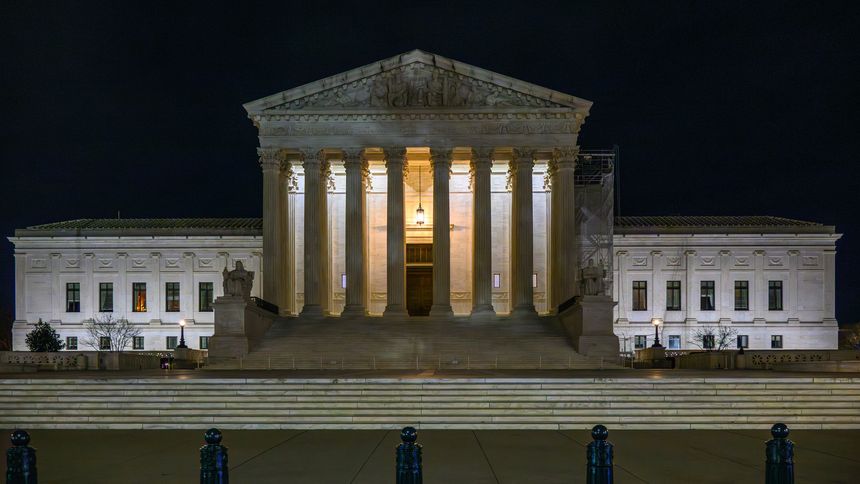





On June 29, 2026, the Supreme Court invalidated the statutory for-cause-removal protections for the commissioners of the Federal Trade Commission. In Trump v. Slaughter, the Court held by 6-3 vote that these commissioners and, by extension, commissioners of other independent agencies designated as such by law, including the Federal Communications Commission, the Nuclear Regulatory Commission, the Federal Energy Regulatory Commission, and the Consumer Product Safety Commission, serve at the pleasure of the President and can be removed without a showing of malfeasance or neglect of duty. Notwithstanding agency enabling statutory provisions to the contrary, the Court found that these officials serve at the pleasure of the President and can be removed at will.
The Supreme Court based its decision on the Constitution’s requirement that the executive power of the United States be vested in a single individual—the President. Adopting the “unitary executive” theory, it reasoned that “[s]ubordinates who exercise the President’s power are subject to removal by him. Then and only then, can they remain accountable to the President, and the President to the people.” The Court did not specify whether its determination about subordinates applied only to agency heads and Commissioners or extended further down an agency’s organizational chart. But under Slaughter, that ambiguity may ultimately be of limited practical consequence, particularly with respect to major issues. The President can direct the agency head to act, and assuming he or she would rather comply than be removed, the agency head or their designees can remove the subordinate official.
The Slaughter decision overrules the Court’s 1935 decision in Humphrey’s Executor v. United States, which had upheld the for-cause-removal protections for the heads of multimember expert agencies that wield “quasi-legislative” and “quasi-judicial” functions. In Slaughter, the Court ruled that the FTC now exercises executive authority because it engages in substantial investigative and prosecutorial functions, and that the President must have unqualified removal authority over anyone who possesses these hallmarks of executive power, notwithstanding the Article I power of Congress to “‘establis[h] by Law’ certain offices, as ‘necessary and proper’ to structure the Executive Branch,” and to create “agencies like the FTC” in the first place.
Immediate Impact on Independent Agencies
The for-cause-removal requirement has long been one of the primary mechanisms through which federal regulatory agencies have retained independence from the President. In addition, independent agencies have not typically been subject to Executive Orders and Presidential Memoranda directed at cabinet departments and other Executive Branch agencies. That changed early last year, when the President signed an Executive Order imposing various mandates on independent agencies.
Included among those mandates, as we described in a prior alert, independent agencies are now required to submit major regulatory actions to the Office of Management and Budget’s Office of Information and Regulatory Affairs for coordination with other agencies prior to adoption. Under Slaughter, an agency head’s refusal to submit to the OIRA regulatory review process can now be enforced through removal of the non-complying official.
Unanswered Questions After Slaughter
It is not clear after Slaughter whether other statutory provisions that confer independence on agencies will survive constitutional scrutiny, and the Court appears to have deliberately not addressed them. For example, there is a question as to whether statutory requirements that an executive agency have no more than a particular number of commissioners who are of the same particular party will be enforceable; just as the President is free to fire agency members at will, he or she should, subject to advice and consent of the Senate, arguably have a free hand in nominating officials, irrespective of Congressional dictates as to party membership. The same is true for statutory provisions calling for agency heads to serve staggered terms, and terms of a particular length.
As noted, also unresolved is whether employees who themselves wield executive authority for agencies—such as by making decisions about who to prosecute and investigate—are subject to removal by the President or at the President’s direction without cause. Fundamentally, an open issue is whether the decision in Slaughter invalidates the statutory protections afforded to any members of the federal civil service employed by independent agencies and the Executive Branch more generally. A broad reading of the decision in Slaughter could mean that all extra-constitutional restrictions placed on who a President can employ or fire, from agency heads down to employees not engaged in policymaking or executive functions, are unconstitutional.
The Federal Reserve Exception
The Slaughter decision appears to be applicable to all types of federal regulatory agencies, such as the FTC, FCC, the NRC, FERC, and the CPSC—all of which relied on Humphrey’s Executor for their independence—with one notable exception. In Trump v. Cook, a decision also issued on June 29, the Court recognized the independence of the Federal Reserve System based on its historical lineage as the successor to the First and Second Banks of the United States. Stressing the Fed’s unique pedigree, the Court declined to overturn a stay, previously issued by the lower courts, that had prevented the termination of a member of the agency’s Board of Governors. The Slaughter and Cook decisions were both written by Chief Justice Roberts, but neither decision goes to great length to acknowledge the other or explain how they are consistent.
The decision in Slaughter may have differing implications for different agencies and the parties they regulate in the short term. And it is of course important to remember that, in the long term, the implications will depend to a greater extent on who sits in the Oval Office—what is true today may not be true for future presidencies.
Broader Implications for Regulation and Governance
A final and much broader issue that the opinions in Slaughter raise (in particular, the concurring opinion by Justice Gorsuch) is the question of whether Congress would have agreed to grant agencies as much power as it did, including legislative and rulemaking authority, if it had known that the agency heads could be terminated by the President. Indeed, many of the independent agencies were granted broad authority precisely because it was anticipated that the agency heads would exercise their judgment and expertise without political influence. Justice Gorsuch further noted that the accumulation of executive, legislative, and judicial authority within a single agency accountable to the President may offend the Constitution and suggested that courts should apply tools such as the nondelegation and major questions doctrines to prevent encroachment by the executive branch into legislative and judicial domains.
Yet, for businesses seeking a stable regulatory environment in which to operate, the sharper and faster policy reversals following each inevitable political change in administration may create challenges that are increasingly difficult to navigate.
Key Takeaways
- In Trump v. Slaughter, the Supreme Court held that all executive authority is ultimately vested in the President, and that the President must be able to compel agency heads, even commissioners of statutorily independent agencies such as the FTC, FCC, NRC, FERC, and CPSC to exercise executive authority in accordance with his or her priorities or face removal without cause.
- Following Slaughter, regulated parties should expect such independent agencies’ adjudicatory, rulemaking, and enforcement decisions to hue more closely to the priorities of the President, and they should anticipate that agency heads and senior officials exercising delegated authority at the direction of the agency head will take action and exercise judgment in a manner that aligns with the President’s instructions.
- With respect to many issues, the President and senior Administration officials setting policy direction will likely not have expressed a particular preference, and regulated parties should expect the typical ebb and flow of regulation and changes in priorities from administration to administration.
- Parties adversely affected by agency action retain the ability to seek judicial review, and traditional avenues for challenge to agency action, such as that the agency action was arbitrary and capricious, contrary to law, or not supported by the record, remain in place. Though now, agencies will have a freer hand to pursue the policy preferences of the President and the administration and, with the President’s at-will removal power cemented by the Slaughter Court, have a particularly strong incentive to do so.
- At the same time, the Supreme Court’s 2024 decision in Loper Bright Enterprises v. Raimondo leaves reviewing courts wider latitude to apply their own judgments as to the legality of agency actions under their enabling statutes, without deference to statutory interpretations advanced by the agency. And the Slaughter decision may increase the likelihood that an agency may choose not to pursue cases or defend actions initiated under or against a prior administration of a different party.
- Regulated parties should also anticipate the potential for regulatory uncertainly or even agency gridlock, given that some critical agency regulatory functions are not amenable to “acting” or delegated authority should expanded presidential removal power ultimately clash with a Senate confirmation authority that will only be more important as a remaining lever of congressional influence following Slaughter.
/Passle/6878183c1547331efeed13be/SearchServiceImages/2026-08-14-18-00-28-948-6a7f57bcf6245dcc0e84c8b4.jpg)
/Passle/6878183c1547331efeed13be/SearchServiceImages/2026-08-06-14-12-11-890-6a74963bf96ff179f854a7d0.jpg)
/Passle/6878183c1547331efeed13be/SearchServiceImages/2026-08-03-17-36-32-417-6a70d1a0b949cf9a2cde52c5.jpg)