


Multiple significant changes to the H-1B program occurred in 2025. For employers, planning for the impacts of these changes is crucial. Specifically, changes to the H-1B cap registration process and the addition of the $100,000 H-1B visa fee—announced via presidential proclamation on September 19, 2025, (and recently upheld by the U.S. District Court for the District of Columbia on December 23, 2025)—can bring challenges to employers who have not prepared. Add in the possibility of another government shutdown with the January 31, 2026, funding deadline, and employers may experience the most complicated H-1B cap season in many years.
I. No Longer Random: The New Weighted Selection Process via the H-1B Cap Registration Rule
When Will the Weighted Selection Rule Be Implemented?
This rule will be effective on February 27, 2026, in time for the upcoming FY 2027 registration period, which is set to begin in March 2026.
How Does the Weighted Selection Rule Work?
USCIS will weight and select the registrations for unique beneficiaries (or petitions) received based on the highest OEWS (Occupational Employment and Wage Estimates) wage level that the beneficiary’s proffered wage will equal or exceed for the relevant SOC code (standard occupational code) in the area(s) of intended employment. Specifically, registrations for unique beneficiaries or petitions will be assigned to the relevant OEWS wage level and entered in the selection pool as follows:
- Wage Level IV will be entered into the selection pool four times
- Wage Level III will be entered into the selection pool three times
- Wage Level II will be entered into the selection pool two times, and
- Wage Level I will be entered into the selection pool one time
What Information Must Employers Include on the Registration and Petition?
For purposes of the weighting and selection process, a registrant will be required to:
- Select the box for the highest OEWS wage level (‘‘wage level IV,’’ ‘‘wage level III,’’ ‘‘wage level II,’’ or ‘‘wage level I’’) that the beneficiary’s proffered wage equals or exceeds. (Note: there are different requirements where there are multiple worksite locations that are discussed below).
- Provide the SOC code for the proffered position and area of intended employment that served as the basis for the OEWS wage level indicated on the registration.
When filing the H-1B petition if the registration is selected, submit evidence of the basis for the wage level selected on the registration as of the date that the registration underlying the petition was submitted. See new 8 CFR 214.2(h)(8)(iii)(D)(1). Such evidence may include a printout from the DOL OFLC Wage Search website for the beneficiary's SOC code and areas of intended employment as of the relevant date; also, if using an alternative salary survey in the petition filing, the Employer should submit evidence appropriate for that wage source. (Be sure to save dated screenshots/printouts of wage data used).
Why is USCIS Shifting from a Random Lottery Selection to the Weighted Selection?
DHS indicates that the weighted registration is expected to increase average salaries among selected H-1B cap-subject workers, while also better protecting the wages, working conditions, and job opportunities of U.S. workers.
Why is DHS Using OEWS Wage Data?
In determining how to rank and select registrations (or petitions, as applicable) by wage level, DHS indicates most registrants and petitioners are familiar with the OEWS wage levels as they have been used by DOL in the foreign labor certification process since 1997. Further, the OEWS prevailing wage level data is publicly available through DOL’s Foreign Labor Application Gateway (FLAG) system. In contrast, wages based on alternate sources, such as private wage surveys, collective bargaining agreements, and SCA wage determinations, are not always publicly available and do not always have four wage levels.
How is the Registration Completed if an Employer Typically Uses an Alternative Wage Survey?
DHS indicates that Petitioners may continue to use private wage surveys and other alternative wage sources to establish that they will be paying the beneficiary a required wage. However, the H-1B rule will weigh registrations based on the highest OEWS wage level that the proffered wage equals or exceeds since OEWS wage data is the most comprehensive and objective source for comparing wages. Counsel recommends seeking legal advice for analyzing use of alternative wage surveys on H-1B cap registration selections.
Using OEWS Data to Complete the Registration - Example 1
To see how this will be implemented, please refer to the wage data provided below, which is current as of January 7, 2026. Please presume an example where the proffered position is for a Sr. Software Engineer working in Silicon Valley in Santa Clara County, California. According to the position's requirements, the employer determines that the Level IV wage must be paid. Pursuant to the applicable OEWS wage data, the Level IV wage is $264,514. The employee's offered salary is $275,000. On the H-1B registration submission, the employer would indicate the Level IV wage would be used. Once Petitioner files the H-1B petition, the LCA (Labor Condition Application) would also demonstrate the Level IV wage is to be paid.
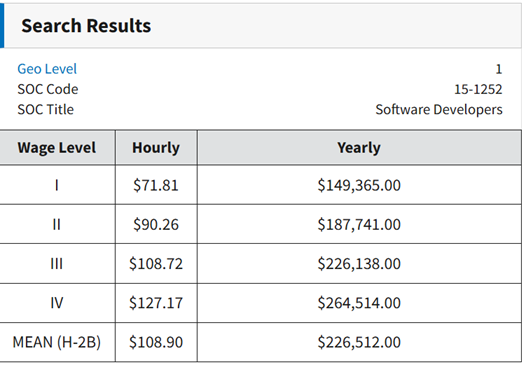
However, if the offered salary was $255,000 instead of $275,000, then the Level III wage would need to be selected on the registration since $255,000 is less than the Level IV wage of $264,514 and therefore does not meet or exceed the Level IV wage.
Using OEWS Data to Complete the Registration- Example 2 (Alternative Salary Survey)
Assume the same facts as above—where the employer must register an experienced Sr. Software Engineer in Santa Clara County, California, but this employer typically uses alternative wage surveys to determine compensation. The employee’s offered salary is $225,000. The alternative salary survey shows the Sr. Software Engineer with that number of years of experience that would be equivalent to Level IV on the OEWS wage data would receive a salary of $221,000. Despite the alternative salary survey indicating an appropriate wage is $221,000, the Employer must select Level II on the H-1B cap registration since the offered salary of $225,000 does not meet or exceed Level III or Level IV OEWS wage data (as shown above). Thus, even though an employer may use the alternative salary survey to prove it meets the requirement to pay the appropriate wage for the position, the weighted registration only considers the OEWS data.
Additionally, employers should consider that when a commenter to the proposed rule indicated that those petitioners who use private surveys will be disadvantaged by the weighting rule, DHS responded by indicating that employers who use a private wage survey may choose to increase the proffered wages of their prospective beneficiaries to increase their chances of selection.
However, if a private survey demonstrates that an employer may offer a salary less than the stated OEWS Level I wage, USCIS will allow the employer to select the Level I OEWS wage even if the OEWS Level I wage is not going to be met. This exception only applies under these circumstances related to Level I wages.
How Does the Weighted Selection Rule Work Where an Employer Indicates Multiple Locations for the Area of Intended Employment?
A registrant is required to provide the SOC Code for the proffered position and area of intended employment serving as the basis for the OEWS wage level indicated on the registration. If a beneficiary may work from more than one worksite where the OEWS wage data for each area differs, the employer must submit the H-1B registration on behalf of that individual with the OEWS wage data corresponding to the lowest wage level associated with all the locations. See new 8 CFR 214.1(h)(8)(iii)(A)(5)(i).
What if the Proffered Position, Work Location(s), or Salary Changes After the H-1B Cap Registration Is Submitted?
The H-1B petition filed after registration selection must contain and be supported by the same identifying information and position information, including SOC code, provided in the selected registration and indicated on the LCA used to support the petition. In the comments collected in response to the Notice of Proposed Rulemaking, DHS indicates that they also expect that the area of intended employment provided at registration will be reflected as a worksite in the subsequently filed petition, such that the petition continues to support the requirement that the registration was based on a bona fide job offer. See new CFR 214.2(h)(8)(iii)(D)(1).
Pursuant to the new rule, USCIS will be able to deny a subsequent new or amended petitions filed by the petitioner, or a related entity, on behalf of the same beneficiary if USCIS were to determine that the filing of the new or amended petition was part of the petitioner’s attempt to unfairly increase the odds of selection during the registration (or petition, if applicable) selection process. See new 8 CFR 214.2(h)(10)(iii). Also, if a new or amended petition includes the same offered wage but changes the work location so that the new wage corresponds to a lower OEWS wage level for the new location than what was indicated on the registration, USCIS will consider that change in determining whether the location change was an attempt to unfairly increase the odds of selection. This rule will apply regardless of the reason for relocation and whether it was employer or employee driven.
The final rule will allow USCIS to deny a subsequent new or amended petition or revoke an approved petition if USCIS were to determine that the filing was part of the petitioner's attempt to unfairly increase odds of selection during the registration selection. It is unknown what criteria USCIS would use to determine that a subsequent petition was filed in an attempt to “game the system”. According to DHS responses to comments, this would be determined on a case-by-case basis.
How Does the Weighted Selection Rule Work Where Multiple Employers Seek to Register the Same Foreign National in the H-1B Cap Registration?
Where a beneficiary has multiple registrations, the unique beneficiary will be aligned with the lowest wage level of all registrations submitted on his or her behalf.
Key Takeaways:
- The new weighted H-1B cap registration rule is a complete change from the random lottery conducted in previous years.
- Since the H-1B cap registrations selected will favor those where the OEWS wage levels indicated at the time of registration are the Level III or Level IV wages (since those submitted registrations will have a greater chance of being selected), employers should review which registrations absolutely must be selected due to any relevant max out dates in other statuses (i.e. someone who will not be able to adjust status before their time in L-1 status or another status maxes out), and ascertain whether those employees may be able to be aligned to one of the higher OEWS wage levels.
- Additionally, if employers have any mission critical foreign national employees (where a lapse in authorized employment could be devastating to the business) who are working pursuant to an Employment Authorization Document (EAD) without any underlying status, employers should consider whether they may be included in the H-1B cap registration list since effective October 30, 2025, certain foreign national employees who submit EAD renewal applications no longer receive automatic extensions except in limited circumstances. See End of Automatic Extension of EAD. Long pending EAD applications may lead to lapses in authorized employment.
- Litigation to halt implementation of the rule before the H-1B cap lottery registration opens could always be initiated, but it may not be likely to halt implementation at this point.
II. The $100,000 H-1B Question
Another significant change applicable to H-1B petitions filed this H-1B cap season is the new $100,000 H-1B fee announced via the presidential proclamation released on September 19, 2025- Restriction on Entry of Certain Nonimmigrant Workers - with a near immediate effective date of September 21, 2025. Following many unanswered questions, related to how and/or if the $100,000 fee applied to various scenarios, USCIS released guidance on October 20, 2025, clarifying certain questions as outlined here: H-1B Specialty Occupations | USCIS. Based on the clarifying guidance, these are the circumstances where the $100,000 H-1B fee is required.
H-1B $100,000 Payment Required:
- The payment is required for new H-1B petitions filed at or after 12:01 AM Eastern Daylight Time (EDT) on September 21, 2025, on behalf of a beneficiary outside the U.S. without a valid H-1B visa.
- The fee is required for H-1B petitions filed at or after 12:01 AM EDT on September 21, 2025, where the petition requests consular notification, port of entry notification, or pre-flight inspection for an individual inside the U.S.
- If a sponsored employee leaves the U.S. before receiving any decision on an H-1B change of status application filed at or after September 21 at 12:01 AM EDT, then the payment would be required since the employer’s request would be treated as a request for a consular approval.
In conclusion, the payment is required where an H-1B petition is filed on or after 12:01 AM EDT September 21, 2025, on behalf of someone who is outside the U.S. without a valid H-1B visa or where the H-1B filing requests consular notification, port of entry notification, or pre-flight inspection entry notification.
Litigation Update:
The U.S. Chamber of Commerce filed a lawsuit against the Trump Administration on October 16, 2025, in which it argued the proclamation and its implementation were beyond the bounds of the President’s authority under law and that implementation violated the Administrative Procedures Act. That same month, the Association of American Universities (AAU) joined the U.S. Chamber in an amended suit. On December 23, 2025, the U.S. District Court ruled that the President has broad authority to restrict noncitizens’ entry. Then, January 6, 2026, the D.C. Circuit fast-tracked the U.S. Chamber’s appeal of the ruling. Appeals briefs are due January 9, 2026, and the reply from the Trump Administration is due by January 30, 2026.
There are at least three lawsuits against the Trump administration in relation to the $100,000 fee, for example: Trump Admin Beats Chamber Suit Over $100K H-1B Visa Fee - Law360
Key Takeaways:
- Employers should consult with legal counsel to ensure they understand their payment liability for their potential H-1B cap population.
- Because of reports of less international student enrollment overall and due to the H-1B weighting rule, overall foreign student H-1B cap registration is expected to be lower than in previous years, while those employees who are already in the U.S. and who have more experience/higher salaries may have greater odds of selection in the FY 2027 H-1B cap registration.
- Employers that typically file H-1B cap petitions for those outside the U.S. and request consular notification may file less registrations this year than in the last several years due to the uncertainty of the $100,000 H-1B fee and the uncertainty of litigation efforts.
- Litigation continues regarding the legality of the $100,000 payment so guidance may change again- but is not expected to change soon enough to ease any impact to this year’s H-1B cap registration planning.
- Because of the above, employers are cautioned to start H-1B cap planning early and to consult with qualified legal counsel to stay abreast of changes. Based on the H-1B weighting rule discussed above, employers may need to do wage analysis and start LCAs to ensure the company is comfortable with the wage level that will need to be selected for a given individual who is nominated by an employer to participate in the FY 2027 H-1B cap registration.
III. Possible Government Shutdown January 31, 2026
Employers also must consider that specific agencies in the government face a looming shutdown if certain measures are not taken by Congress before the January 31, 2026, expiration of the Continuing Resolution. Among these agencies are the Department of Homeland Security (DHS), which includes the U.S. Citizenship and Immigration Services (USCIS), Customs and Border Protection (CBP), and Immigration and Customs Enforcement (ICE); the Department of Labor (DOL), and Department of State (DOS).
While USCIS and DOS functions are fee-based and therefore would likely remain open in the event of a shutdown, DOL does not require any fees for the submission of LCAs or PERM applications (first step in the green card process). Accordingly, the wage information available in the DOL system such as OEWS wage data may become unavailable for employers seeking H-1B cap registrations. If an employer has not prepared in advance and does not have relevant wage information in advance of January 31, 2026, there is the risk that information could be unavailable for some unknown time period.
Key Takeaways:
- Employers must plan early and consult with legal counsel to ensure they are prepared in advance for answering the questions regarding OEWS wage levels asked as part of the new weighted H-1B cap registration in case the DOL website goes down.
- Employers should ask counsel to monitor the status of the government shutdown so there are no surprises if DOL’s FLAG system (along with OEWS wage data) is offline.
/Passle/6878183c1547331efeed13be/SearchServiceImages/2026-07-08-13-49-13-579-6a4e5559da24724bd1f35a73.jpg)
/Passle/6878183c1547331efeed13be/SearchServiceImages/2026-07-06-18-22-30-019-6a4bf2665c05f02be1d4f87f.jpg)
/Passle/6878183c1547331efeed13be/SearchServiceImages/2026-07-06-19-55-17-284-6a4c0825952dd6ae5cfe9a00.jpg)