



Daniel Casares-Lauritsen, Chief Operating Officer and Head of Corporate Business Development at First Law International (FLI) co-authored this article.
Executive Summary
On June 3, 2026, President Trump issued an Executive Order entitled Strengthening Customs Enforcement. The Order directs the Department of Homeland Security ("DHS") and U.S. Customs and Border Protection ("CBP") to undertake what may become the most significant overhaul of customs compliance and importer accountability requirements in decades.
Although the Executive Order itself does not immediately change customs regulations, it directs DHS and CBP to revise regulations, policies, and enforcement practices over the coming months. The Order reflects a view within the Administration that existing customs procedures contain vulnerabilities that permit duty evasion, undervaluation, transshipment, importer-of-record abuses, forced labor violations, and other forms of customs fraud.
The Executive Order is particularly significant because it places the importer of record ("IOR") at the center of customs enforcement policy. The Administration appears to be moving toward a system in which importers must demonstrate a substantial and legitimate U.S. presence and can be held directly accountable for customs obligations. In particular, the Executive Order suggests that DHS and CBP may increasingly scrutinize importer structures that rely on lightly capitalized or operationally limited U.S. entities to serve as Importers of Record.
For importers, customs brokers, foreign manufacturers, and supply-chain participants, the Order signals an enforcement environment characterized by heightened disclosure requirements, expanded audits, increased penalties, more aggressive bond enforcement, and greater scrutiny of importer structures and supply-chain documentation.
What the Executive Order Does
The Executive Order begins with a broad statement that customs enforcement is essential to national security, foreign policy, revenue collection, product safety, intellectual property protection, and compliance with numerous federal laws. The Administration states that existing customs systems contain "systemic inefficiencies, loopholes, insufficient enforcement mechanisms, and outdated processes" that have allowed importers to evade duties and avoid accountability.
The Order directs DHS to undertake a comprehensive review of importer eligibility requirements and customs enforcement procedures.
Among the most notable provisions are directives requiring DHS and CBP to:
- Revise importer eligibility standards. Importers may be required to provide additional information regarding beneficial ownership, business affiliations, operational activities, and anticipated import volumes when registering with CBP.
- Impose enhanced vetting requirements for importers and other customs participants. CBP appears likely to increase scrutiny of parties participating in import transactions, including beneficial ownership structures and relationships among affiliated entities.
- Establish new disclosure and certification obligations. Importers may be required to provide additional certifications relating to supply-chain compliance and disclose more detailed information regarding sourcing, manufacturing, and production activities.
- Strengthen customs audits and enforcement activities. CBP is expected to increase enforcement activity relating to forced labor, valuation, tariff classification, transshipment, duty evasion, and investigations under the Enforce and Protect Act ("EAPA").
- Revise penalty mitigation policies. The Executive Order contemplates stricter penalty practices, including minimum penalty thresholds and reduced opportunities for mitigation in certain circumstances.
- Increase transparency regarding customs enforcement activities. CBP is expected to publish additional information regarding enforcement priorities, activities, and outcomes.
- Develop legislative proposals for additional customs enforcement reforms. DHS is directed to develop recommendations for further statutory changes designed to strengthen customs enforcement authorities.
The centerpiece of the Order is its treatment of importers of record.
The Order establishes a more restrictive, substance-based framework for distinguishing between U.S. and foreign Importers of Record. For entities, U.S. IOR status turns on U.S. organization, U.S. location, controlling beneficial ownership by U.S. citizens or lawful permanent residents, or ownership of significant U.S. real property, as further defined by DHS.
The Order also directs DHS to define what it means to be “located in the United States,” prioritizing prevention of shell companies, sham transactions, and artificial corporate structures. At a minimum, the entity must maintain a principal place of business in the United States, conduct significant U.S. business activity through a physical presence, and possess sufficient tangible U.S. assets in light of the scale of its operations and any relationship to a foreign manufacturer.
This language is noteworthy because it goes far beyond traditional customs concepts. The Order is not merely concerned with who files entry documents. Rather, it seeks to identify who is genuinely responsible for imported merchandise and capable of satisfying customs obligations.
Foreign IOR Restrictions Are Among the Clearest Near-Term Changes
One of the most significant aspects of the Executive Order is that it does not merely direct future study of foreign Importers of Record. Instead, it directs DHS to adopt several specific measures aimed at foreign IOR participation in the customs process.
Among other things, the Order directs DHS to prohibit foreign IORs from filing informal entries, impose heightened requirements on foreign IORs using formal entry procedures, and limit foreign IOR reliance on continuous bonds unless CBP determines that revenue collection and compliance objectives would be adequately protected.
The Order also contemplates enhanced compliance expectations for foreign IORs participating in formal entry. Depending on how DHS implements these provisions, foreign IORs may be required to participate in CTPAT, where eligible, or utilize a CTPAT-validated customs broker.
These provisions could have significant implications for cross-border e-commerce models, foreign sellers utilizing U.S. fulfillment arrangements, and foreign manufacturers that have historically relied on limited U.S. operational infrastructure to support U.S. import activity.
At a minimum, the Executive Order signals that foreign IOR participation is no longer being viewed solely as a customs-entry issue. Rather, DHS appears increasingly focused on whether foreign importers possess sufficient compliance capabilities, financial accountability, and operational infrastructure to support ongoing participation in the U.S. import system.
A Key Area of Likely Scrutiny: Import Conduit Structures and Affiliated Importers
Although the Executive Order contains several provisions directed specifically at foreign IORs, one of its broader implications may involve multinational manufacturers that utilize affiliated U.S. entities as Importers of Record.
The Executive Order repeatedly emphasizes importer substance, tangible U.S. assets, meaningful domestic operations, and financial accountability. Taken together, these themes suggest that DHS and CBP may increasingly focus on whether the entity serving as Importer of Record represents a genuinely accountable participant in the import transaction.
Many foreign manufacturers currently utilize affiliated U.S. subsidiaries to act as Importers of Record for products manufactured abroad. In many cases, these arrangements are entirely lawful and serve legitimate commercial purposes. Nothing in the Executive Order suggests that affiliated U.S. importer structures are inherently improper. Rather, the Order appears focused on whether such entities possess sufficient operational substance and financial accountability.
Nevertheless, the Executive Order suggests that DHS and CBP may increasingly examine whether affiliated importer entities possess meaningful U.S. operations, employees, assets, and business activities, or whether they function primarily as customs entry vehicles for foreign manufacturers.
Importers should not assume that the Executive Order is directed only at foreign entities acting directly as Importers of Record. The more significant question may be whether DHS and CBP will increasingly look beyond formal corporate structures and evaluate the operational substance, financial responsibility, and practical accountability of the entity serving as Importer of Record.
A recurring theme throughout the Executive Order is collectability. The Administration appears concerned not only with whether duties are properly assessed, but also whether CBP can successfully collect duties, penalties, and liquidated damages when violations are discovered. This concern helps explain the Order's emphasis on importer substance, tangible U.S. assets, bonding requirements, and distinctions between U.S. and foreign importers.
Accordingly, companies utilizing affiliated U.S. entities as Importers of Record should be prepared to demonstrate that those entities possess genuine operational substance within the United States and are capable of satisfying customs obligations independently of their foreign parents.
The Context Behind the Executive Order
The Executive Order did not emerge in isolation.
According to the Administration, increasingly complex global supply chains, cross-border e-commerce platforms, direct-to-consumer imports, and sophisticated corporate structures have strained customs enforcement systems designed for a different era of international trade.
The Administration has specifically identified concerns regarding undervaluation, incomplete disclosures, duty evasion, transshipment, forced labor enforcement, and opaque importer structures that obscure responsibility for imported merchandise. At the same time, CBP has faced growing challenges in identifying accountable parties and collecting duties from entities possessing limited U.S. assets or operational presence.
Independent customs practitioners generally acknowledge these challenges. The growth of e-commerce and multinational supply chains has made it easier for merchandise to enter the United States through entities possessing limited operational substance, few domestic assets, and minimal long-term accountability.
At the same time, some trade professionals are likely to question whether aspects of the Executive Order could increase compliance costs for legitimate businesses without necessarily targeting the most significant sources of customs fraud. The principal debate surrounding implementation is therefore likely to focus not on whether customs enforcement should be strengthened, but rather on how aggressively DHS and CBP distinguish between legitimate commercial structures and structures designed primarily to avoid customs obligations.
Customs Compliance as a Core Compliance Function
Many trade compliance professionals may view the Executive Order as part of a broader convergence between customs compliance and other trade-control disciplines. Historically, customs compliance has often been treated as a transactional or administrative function focused on entry filings and duty payments. By contrast, export controls and sanctions compliance have increasingly been treated as enterprise-wide compliance disciplines requiring formal internal controls, screening procedures, management oversight, and documented compliance programs.
The Executive Order suggests that CBP may be moving toward a similar model in which import compliance is expected to be embedded throughout an organization's operations rather than addressed only at the point of entry. In that sense, the Order may be viewed not merely as a customs-enforcement initiative, but as part of a broader trend toward treating trade compliance as a core corporate governance and risk-management function.
Why Now?
The timing of the Executive Order is not accidental.
Over the past eighteen months, the United States has imposed some of the highest effective tariff rates seen in decades through a combination of Section 301 duties, Section 232 measures, reciprocal tariffs, and other trade restrictions. As duty exposure has increased, so too have the economic incentives for importers, exporters, and intermediaries to seek ways of reducing customs costs.
From the Administration's perspective, higher tariffs can achieve their intended policy objectives only if they are effectively enforced. Customs enforcement vulnerabilities - including undervaluation, transshipment, country-of-origin manipulation, duty evasion schemes, and the use of minimally capitalized importer entities - threaten the effectiveness of broader U.S. trade policy.
The Executive Order therefore appears to represent the enforcement counterpart to the Administration's broader tariff strategy. Having devoted substantial effort to increasing tariff rates and other import restrictions, the Administration is now turning its attention to ensuring that those duties are properly assessed, collected, and enforceable.
The Order also reflects a broader shift in how customs administration is viewed within the federal government. Customs enforcement is increasingly being treated not merely as a revenue collection function, but as an instrument of trade policy, industrial policy, supply-chain security, and national security.
How the Executive Order Is Likely to Be Implemented
The Executive Order largely operates through directives to DHS and CBP rather than through immediate legal changes. Accordingly, the most important developments will occur through future regulations, guidance documents, policy statements, and enforcement initiatives.
Several implementation priorities appear likely.
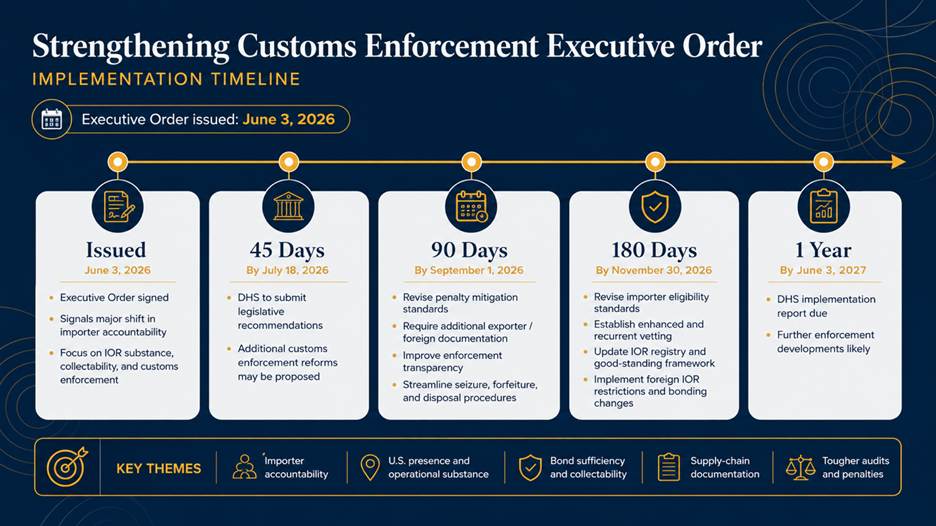
A. Implementation Timeline
The Order is structured around several concrete implementation deadlines. Companies should treat those deadlines as planning milestones rather than wait for final implementing rules before reviewing importer structures, bonds, broker relationships, and documentation readiness.
B. Good Standing, Registry Updates, and Recurrent Vetting
One of the most important operational changes is the creation of an IOR “good standing” framework. DHS must require all IORs to remain in good standing with CBP, taking account of the IOR’s and its affiliates’ compliance history, payment of customs liabilities, enforcement actions, and other relevant considerations.
CBP must also update the IOR registry by removing inactive IORs, confirming active IORs’ compliance with applicable disclosures, and creating risk-based tiers. This points toward recurring importer surveillance rather than a one-time onboarding check.
C. Greater Scrutiny of Importer-of-Record Structures
Consistent with the concerns discussed above, importers should expect increased requests for information regarding ownership structures, beneficial ownership, operational activities, assets, and relationships among affiliated entities.
D. Enhanced Documentation Requirements
The Order directs DHS and CBP to establish expanded disclosure and certification requirements. These may include foreign tax and business identifiers, ownership and beneficial-ownership disclosures, business-affiliation disclosures, domestic-asset disclosures, manufacturer product identifiers, product specifications, and documentation or information the foreign exporter was required to submit to the foreign customs administration before export to the United States.
This trend would be consistent with CBP's broader movement toward supply-chain transparency in areas such as forced labor enforcement, country-of-origin verification, and AD/CVD enforcement.
E. Increased Bonding and Financial Security Requirements
The Order repeatedly emphasizes revenue collection and accountability. Accordingly, CBP may increasingly rely on higher bond requirements, restrictions on continuous bonds for certain foreign importers, and more aggressive liquidated damages enforcement.
Importers with substantial duty exposure should expect renewed scrutiny of bond sufficiency.
F. More Aggressive Penalty Enforcement
Perhaps the clearest enforcement signal concerns penalties.
The White House fact sheet indicates that DHS will establish a minimum penalty floor limiting CBP's discretion to reduce assessed penalties. The Administration specifically references a minimum mitigation floor of fifty percent of the assessed penalty.
Historically, mitigation practices have often allowed substantial reductions in penalties when importers cooperated and demonstrated corrective action. The new approach suggests that negotiated reductions may become significantly more difficult to obtain.
Connection to the Ongoing IEEPA Tariff Refund Process and Recent DOJ Appeal
The Executive Order arrives at a time when CBP is administering one of the largest customs refund programs in U.S. history following the Supreme Court's invalidation of tariffs imposed under the International Emergency Economic Powers Act ("IEEPA").
At first glance, the Executive Order and the refund process appear unrelated. The refund program concerns duties previously collected, while the Executive Order focuses on future customs enforcement. Nevertheless, both developments place unusual emphasis on the identity and accountability of the Importer of Record.
At present, there is no indication that CBP intends to revisit historical importer-of-record determinations for purposes of denying otherwise valid refund claims. However, information submitted during the refund process may provide CBP with additional visibility into importer structures that could later become relevant in enforcement initiatives undertaken pursuant to the Executive Order.
A recent Department of Justice appeal has added further uncertainty to the IEEPA tariff refund process. DOJ is challenging the Court of International Trade's universal refund order to the extent it requires CBP to reliquidate finally liquidated entries and issue refunds to importers that did not themselves bring claims before the CIT.
This development does not appear to alter the central purpose of the Executive Order, which is prospective customs enforcement reform. Nor does it suggest that CBP will use the Executive Order to revisit otherwise valid refund claims. However, the appeal underscores an important practical point: refund recovery increasingly depends on accurate entry-level records, liquidation status, Importer of Record identity, refund-claim preservation, and the ability to establish entitlement through the appropriate procedural channel.
For importers, the practical lesson is straightforward. Companies should continue to treat the refund process and the Executive Order as separate legal developments, while recognizing that both place a premium on accurate importer records, reliable documentation, and careful compliance management.
Implications for Foreign Manufacturers and Exporters
Although the Executive Order is directed primarily at customs enforcement within the United States, its effects are likely to be felt throughout international supply chains.
Foreign manufacturers exporting products to the United States should not assume that the Executive Order is relevant only to U.S. importers. Many foreign companies exercise substantial influence over import transactions through affiliated U.S. subsidiaries, related-party distributors, fulfillment arrangements, or other entities serving as Importers of Record.
As discussed above, the Executive Order signals increased focus on importer accountability, operational substance, and financial responsibility. Foreign manufacturers should therefore expect greater scrutiny of U.S. import structures and increased requests for information relating to ownership, supply chains, country-of-origin determinations, and relationships among affiliated entities participating in import transactions.
The Executive Order may also encourage some foreign exporters to revisit existing U.S. distribution and import models. Depending on how DHS implements the Order, businesses may determine that additional investment in U.S. compliance infrastructure, personnel, and assets is warranted, while others may prefer to work through established U.S. distributors or other importers capable of demonstrating substantial U.S. presence and customs compliance capabilities.
More broadly, the Executive Order reflects an ongoing trend toward greater supply-chain transparency and accountability. Foreign manufacturers should anticipate increased expectations regarding documentation, traceability, and compliance oversight throughout the import process.
Implications for Customs Brokers
Although the Executive Order focuses primarily on importers, customs brokers are likely to experience more direct effects than this framing may initially suggest.
The Order specifically contemplates recurrent vetting of customs brokers and other parties involved in import activity. It also directs DHS to impose maximum penalties for brokers who fail to conduct due diligence, repeatedly represent noncompliant clients, or fail to cooperate in a timely manner with CBP information requests.
Accordingly, broker compliance programs should focus on client onboarding, IOR validation, ownership and affiliate screening, escalation protocols, recordkeeping, disengagement criteria for high-risk clients, and procedures for responding to CBP requests.
Implications for Importers
Importers should carefully evaluate whether their existing customs structures would withstand scrutiny under the principles articulated in the Executive Order.
Particular attention should be given to importer-of-record arrangements, relationships with foreign affiliates, customs bond sufficiency, valuation procedures, country-of-origin determinations, supply-chain documentation, and forced labor compliance programs.
Importers seeking IEEPA tariff refunds should separately track CAPE eligibility, liquidation status, protest deadlines, CIT filing considerations, and refund-recipient information, particularly for entries that may fall outside CAPE Phase 1.
What Companies Should Do Now
Companies should use the implementation period to test whether their import structures would withstand the substance, collectability, and documentation expectations reflected in the Order. For many companies, the Executive Order may serve as a reminder that customs compliance can no longer be treated solely as a transactional function performed at the time of entry. Instead, DHS and CBP appear to be moving toward a model that places greater emphasis on ongoing compliance, documentation, vetting, and organizational accountability. Companies should use the implementation period to evaluate whether their compliance programs are capable of meeting those expectations.
- Map every IOR used for U.S. imports, including affiliated U.S. subsidiaries and foreign IORs.
- Assess whether each IOR has U.S. employees, tangible assets, a principal place of business, significant business activity, and independent compliance capability.
- Review continuous-bond sufficiency and potential exposure to higher bond requirements or liquidated-damages claims.
- Confirm that beneficial ownership, affiliate relationships, domestic-asset information, and expected import volumes can be documented.
- Review broker onboarding, IOR validation, escalation, and disengagement procedures.
- Prepare for expanded requests for manufacturer identifiers, product specifications, country-of-origin support, forced labor evidence, and foreign-export documentation.
- For IEEPA tariff refunds, separately track CAPE eligibility, liquidation status, protest deadlines, CIT filing considerations, and refund-recipient information.
Key Takeaways
The Executive Order reflects a significant shift in CBP's approach to importer accountability. Rather than treating importer status primarily as a registration concept, the Order contemplates an ongoing compliance framework built around operational substance, financial accountability, disclosure obligations, good-standing requirements, recurrent vetting, and enhanced enforcement.
The recent DOJ appeal concerning IEEPA tariff refunds reinforces the need for importers to preserve refund rights and maintain entry-level records sufficient to establish IOR identity, liquidation status, refund eligibility, and procedural posture.
Companies utilizing affiliated U.S. importer entities should evaluate whether those entities possess sufficient operational substance, assets, and compliance infrastructure to withstand increased scrutiny under the framework contemplated by the Executive Order.
Businesses engaged in international trade should monitor forthcoming DHS and CBP rulemaking closely. The most significant consequences of the Executive Order are likely to emerge not from the Order itself, but from the regulations, guidance, and enforcement initiatives that follow.
First Law International (FLI) is a leading global legal network and services-provider assisting clients with cross-border legal issues in over 100+ jurisdictions. Headquartered in Brussels (Belgium), FLI streamlines global client projects and provides integrated legal and compliance services under a single global engagement model, and with innovative technologies.
Womble Bond Dickinson is a full-service business law firm with 40 offices in the U.S. and U.K. and a network of 1,300+ lawyers. Founded over 150 years ago, the firm delivers high-touch client service and strong local connections with international reach. Womble Bond Dickinson goes beyond business as usual to offer “A Point of View Like No Other”.
/Passle/6878183c1547331efeed13be/SearchServiceImages/2026-07-17-14-10-50-106-6a5a37eaa543841e34e7b987.jpg)
/Passle/6878183c1547331efeed13be/SearchServiceImages/2026-07-16-13-49-44-192-6a58e178c8545c9178cd5642.jpg)
/Passle/6878183c1547331efeed13be/SearchServiceImages/2026-07-15-13-39-17-604-6a578d855b77ac71bbc79e58.jpg)